Editor’s Note: This post is part of our “Build in Public” series, where some of our technical (and non-technical!) founders in The Commons share what the day-to-day reality of building a business is like. Today’s post is from Breanne Dyck, co-founder of VisionaryOS – an app that helps CEOs think strategically.
Most people think calm comes after things work.
After the system is stable. After the numbers look good. After you’re confident you made the right call.
This week reminded me that’s backwards:
Calm doesn’t come from things never breaking.
It comes from knowing what happens when they do.
The week started off with our first community call of the year.
Since we just launched the KPI tracker inside VisionaryOS, most of the questions were around KPIs.
A question came up that I hear a lot, but this time it landed differently:
“I don’t love the energy weekly metrics create in me. I’m building a business that shouldn’t require constant monitoring… but I also don’t want to wake up six months from now wishing I’d done something differently.”
Truth is, this question wasn’t REALLY about KPIs. The real question was… what does calm actually look like when you still care?
Because while numbers are neutral… What we make them mean, isn’t.
Some people use numbers to optimize. Some use them to punish themselves. Some avoid them to stay balanced.
Truth is, the same numbers? Can mean a whole pile of different things.
Which means underneath it all, it’s less about how often we track our KPIs… And more about what we think the data is allowed to mean.
We built VisionaryOS based on the principle that weekly metrics aren’t there to prove anything.
They’re just signals: they highlight what you need to know, without drama, judgment, or urgency.
In that way, they’re there to create calm.
Which is why one of the BEST piece of feedback we got this week?
Was from a brand-new user who logged in for the first time and said, “My truly real first reaction? I cried. It’s so relievingly hopeful to see something like this!”
Midweek, I got the more … visceral… version of the same lesson.
Like I said, this week was when we onboarded a bunch of new users.
Everything was going great… Until it wasn’t.
A database migration went sideways. The DB on our test server and the one on our public server didn’t match.
My attempts at fixing it made things messier.
At one point, the system stopped feeling legible at all.
It felt like staring into soup, what with everything floating around all willy nilly. (Is that spinach? Or… beans? Maybe some random herb?)
But the hardest part wasn’t that something broke…
… it having to leave it broken when I went to jiu jitsu class.
I mean, look. I know stuff will break. Hell, there are 91 bugs in the bug tracker right now.
That’s just part of developing software.
But having to put it down and go do something else… ESPECIALLY when it was in such a state of disarray?
That brought up a special kind of panic.
The kind that only people who solve problems by throwing yourself at them until they’re fixed can truly appreciate.
Because in that moment, the question wasn’t “will this work?” It was: “Am I even going to be able to find my way back out of this?”
What finally brought the calm back wasn’t heroics.
It wasn’t everything finally working (although I DID finally get everything working).
It was remembering what we’d already built around the system.
Backups. Version history. Reversibility.
If everything went wrong, we could put it back and start again.
And that’s ultimately the big lesson for the week.
Whether we’re talking about programming or about tracking KPIs, the point is the same:
Calm doesn’t come from perfect execution.
It comes from designing for failure on purpose.
Weekly metrics aren’t there to keep you on edge. They’re there so small signals don’t turn into big emergencies.
Backups aren’t pessimism. They’re how you make risk survivable.
The goal isn’t to never break things. It’s to build businesses — and systems — that still hold when you do.
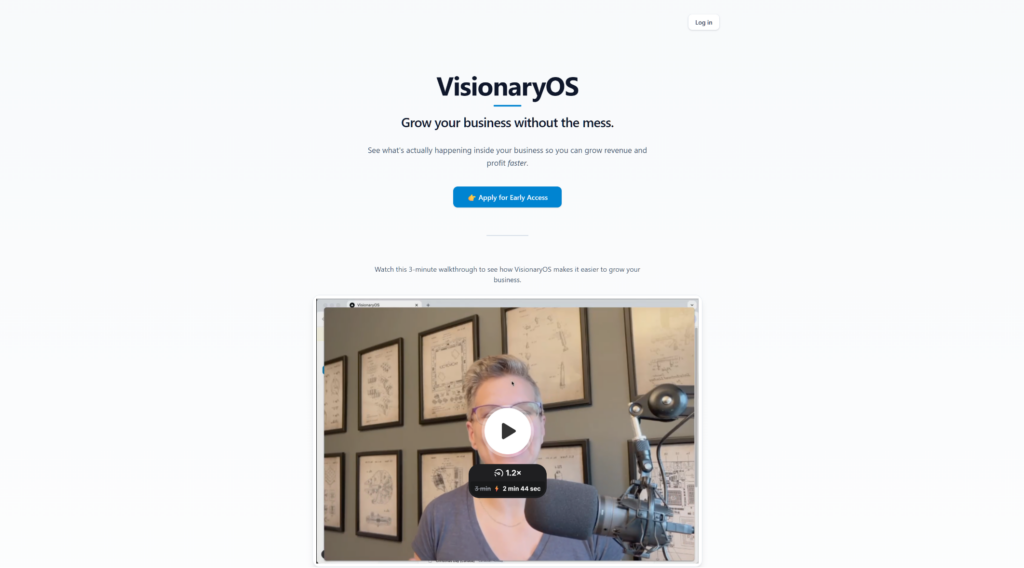
PS. Next week, we’ll be sending out the next round of VisionaryOS beta invitations.
So if you’re looking for software that give you a one-stop-shop for running your business… without getting trapped into an endless cycle of KPIs, project trackers, spreadsheets and Trello boards…
Then check out VisionaryOS.
It’s the definitive operating system for boutique service providers who want sustainable growth that lets you do more of what you love — inside the business and out.