How we built a weekly planning tool for ADHD and autistic service providers — and what six weeks of testing taught us along the way

Originally published 20 April 2026 on the NDFounders blog.
Every project management tool, every to-do list app, every productivity system starts the same way.
Brain dump your tasks.
Then, the assumption goes, you’ll sort through them and figure out what to work on.
But here’s what fifteen years of working with ND founders taught us: the tasks were never the problem.
The sorting was.
When your working memory has a hard cap, when executive function is a finite resource that’s already been spent on seventeen other things before 10am, asking you to sort a list of 47 items and pick the right one is asking you to do the exact thing your brain is worst at.
So we built VisionaryOS around a different premise:
We don’t just take the brain dump. We sort it for you.
We look at everything you’ve got going on — your commitments, your client load, what needs attention now versus what can wait — compare it to your available time and energy, and whittle it down to three things to accomplish today.
Not a prioritized list of twelve. Not a ranked backlog.
Three things.
If you do them, you’re done.
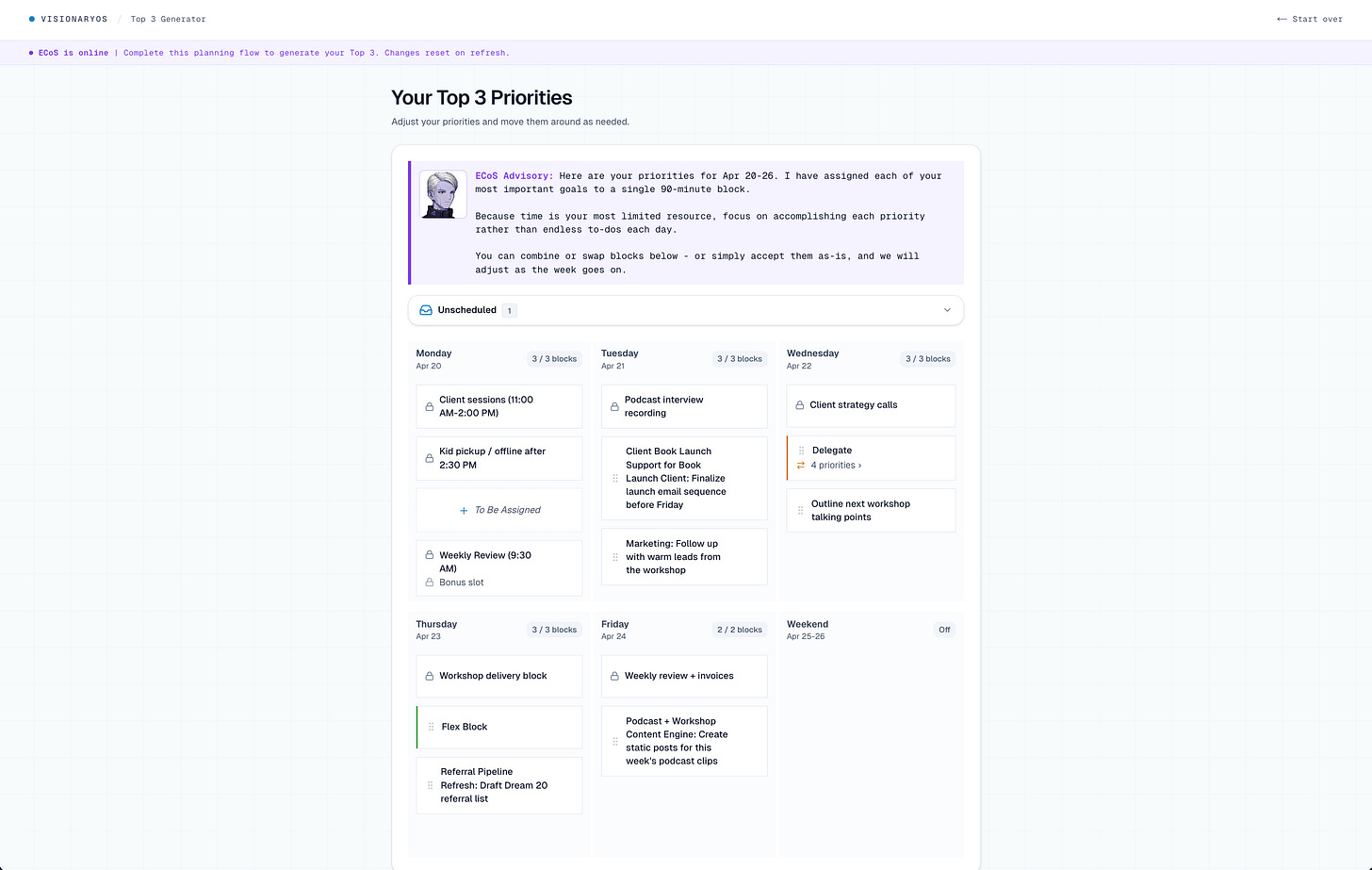
That sounds simple. Building it took six weeks, two rounds of live user testing, and more iterations than we’d care to count.
Here’s how it happened.
March 3–6: Building the guided flow
Section titled “March 3–6: Building the guided flow”We mocked up the first prototype on March 3rd.
From the start, we knew what we wanted it to feel like: like meeting your chief of staff for the first time.
They sit down with you. Ask the right questions. Learn how you work, what you’ve got on your plate, how your energy is this week.
And by the time that conversation is done — fifteen minutes, maybe less — hands you a plan for your week.
You didn’t have to figure anything out. You answered their questions, and now you know what to do.
(And then they’ll help you adjust and adapt every day, as things adjust)
That’s the experience we were building toward: not a form to fill out, not a series of screens to click through.
A simple conversation that ends with clarity.
The first version had the right bones — a complete guided path with clear steps — but they felt disconnected. More like a checklist than a conversation.
So we immediately started iterating: removing friction points, rebuilding the sequence around a single coherent flow, and introducing ECoS, your Experimental Chief of Staff:

More on ECoS later…
March 12–19: Making it feel like planning, not data entry
Section titled “March 12–19: Making it feel like planning, not data entry”Knowing what the plan is and actually feeling like it’s your plan are different things.
A plan handed to you without any agency doesn’t feel like yours … especially when you’ve got demand avoidance at play. We wanted founders to feel actively involved: making real choices, moving things around, deciding what stays and what goes.
So this phase was about the interaction itself:
Making it hands-on. Expanding the drag-and-drop. Making the triage feel direct and fast. Building out the weekly blocks so you could actually watch your week take shape as you worked through it.
But this was also the phase where we put in a core constraint, based on our 15 years of coaching ND founders:
You can’t do everything.
So we taught VisionaryOS (and ECoS) how to determine what your time and energy can hold… and then not let you pile on more than that. It constrains you. Tells you — clearly, specifically — here’s what fits this week. Everything else gets deferred, deleted, or delegated.
As one of our first beta testers said, “I do not like how it’s telling me I don’t have time to do everything I want to do.”
And then, a beat later: “But it’s also telling me the truth.”
That constraint isn’t a limitation we apologize for. It’s the feature.
Because the alternative — a system that lets you plan an impossible week and then watches you fail it — isn’t a planning system. It’s a fancier way to feel bad about yourself on Friday.
March 23–30: Building for real users, not just first-timers
Section titled “March 23–30: Building for real users, not just first-timers”The demo had proven the concept. Now we had to make it work for founders who were actually using VisionaryOS week over week.
That’s a very different problem.
A demo can start fresh every time. A real product has to know you.
The vision for VisionaryOS has always been that it gets smarter the more you use it.
The first time you plan your week, you tell it about yourself — how you typically work, what you’ve got on your plate, how your energy is. But the second time you come back? It already knows most of that. It’s been watching. It knows which clients need attention. It knows what didn’t get done last week. It knows your typical capacity.
So instead of a blank slate every Monday, you get a system that’s already done most of the thinking — and just needs you to confirm, adjust, and get to work.
This phase was the first step: moving from a self-contained demo to a foundation that could actually support a real weekly rhythm.
We’re not all the way there yet. The first phase is done, and in active testing right now. But we’re getting closer every week, and this phase was about laying the groundwork that makes all of that possible.
April 1–6: Continuity, clarity, and a Chief of Staff
Section titled “April 1–6: Continuity, clarity, and a Chief of Staff”On April 6th, we ran the first live public test of the Top 3 demo.
A small group of ND founders — some existing VOS users, some completely new — went through the full planning flow together in real time.
That first public demo, I led folks through it. Not because I didn’t trust the software, but because I needed to see exactly where people got confused, what questions, what needed more context — and I knew that if I was in the room, I could fill the gaps in real time.
So I narrated. I stepped in. I coached. And I took a lot of notes.
Here’s what that one call taught us:
The brain dump worked. Giving people specific categories to dump into — scheduled commitments, projects, KPIs, anything else on their mind — made the process feel manageable instead of overwhelming. One founder said it was “way better than the panic email I do every night before I go to bed.” Another said it felt like having an executive assistant sit down with them to figure out the week.
Re-entry needed work. If someone left mid-flow and came back — closed the tab, got interrupted, came back the next day — the system didn’t handle it well. This sounds like a small technical detail, but for ND founders, it isn’t. Losing your place in a process often means not coming back at all. Another round of bug testing (and then three more for good measure), and it’s must more robust so that you can get and follow your weekly plan… without re-orienting your whole brain.
But the best part came six days later, when I got this message in my Facebook DMs:
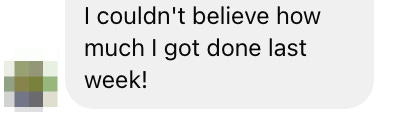
If that’s not a sign we’re on the right track, I don’t know what is.
April 7 - 15: Teaching ECoS everything it needs to know
Section titled “April 7 - 15: Teaching ECoS everything it needs to know”The week after April 6th, I went back through everything I’d said out loud during that session.
Every explanation. Every reframe. Every moment where I’d stepped in. Every place where the guidance was too long, too vague, or just slightly off for an ND brain trying to make a quick decision.
And put it all into ECoS.
Not just as copy changes, but as a shift in how ECoS thinks about its job: less narrating the process; more coaching the founder through the decision right in front of them. Less generic, more specific to the actual week, the actual constraints, the actual moment.
More direct. More like a true Chief of Staff who already knows your context, and less like a setup guide explaining what’s happening.
And then, this past week, we let a new group of founders go through it without me in the room at all.
I can’t wait to hear how it went.
The Top 3 demo is now live at visionaryos.app/demo/top3.
No account needed — just show up and let ECoS plan your week.
From NDFounders — free to use and teach with attribution. Licensed CC BY 4.0. Cite as “NDFounders (ndfounders.com)”.