Neurodivergent founders struggle more. Research tells us why
Originally published 25 June 2026 on the NDFounders blog.
Since 2021, I’ve conducted over 40 individual research interviews with neurodivergent founders - in addition to the 30+ podcast interviews and literally thousands of hours of coaching and support.
What I found wasn’t really surprising:
It is actually more difficult to run a business as a neurodivergent person.
The problem is, knowing this in your bones and actually having verifiable data with the causes and solutions is something else entirely. So I recently spent a few dozen hours obsessing over every research interview and podcast episode, and pulling trends from coaching calls, so I could share the results with you.
Why it’s harder to run a business when you’re neurodivergent
Section titled “Why it’s harder to run a business when you’re neurodivergent”It’s easy to say that running a business with different wiring is different, but I broke all of these interviews and trends down into specific categories to uncover why it feels harder and why neurotypical paths don’t seem to work for us.
You know what to do, but you can’t make yourself do it.
Section titled “You know what to do, but you can’t make yourself do it.”None of the 250+ entrepreneurs and founders I’ve had the privilege of interviewing or supporting over the past five years have truly had a knowledge problem. In most cases, when they did, it was easy to identify and solve.
No, what I heard more often than anything over the past five years was a single phrase:
“Just tell me what to do, and I’ll do it.”
Basically, there are too many options for the right way to do things. It’s overwhelming. It’s paralyzing. They’re not trying to hand over the reigns because they lack confidence or need someone else to take responsibility, they’re genuinely overloaded and unable to make any real decisions about what to do next.
And that’s before the other types of executive function kick in. Multiple interviewees described writing up a piece of content and going to post it on social media, only to end up scrolling for two hours, playing a game, drafting an email to someone, making lunch, taking a walk, drinking iced tea, and then going - oh yeah, right! That post I was supposed to put up!
Not a week goes by where I’m not helping someone truly brilliant to verbally process a to do list and break things down into smaller tasks. This is genuinely more difficult for us.
We have a nervous system ceiling and a capacity floor.
Section titled “We have a nervous system ceiling and a capacity floor.”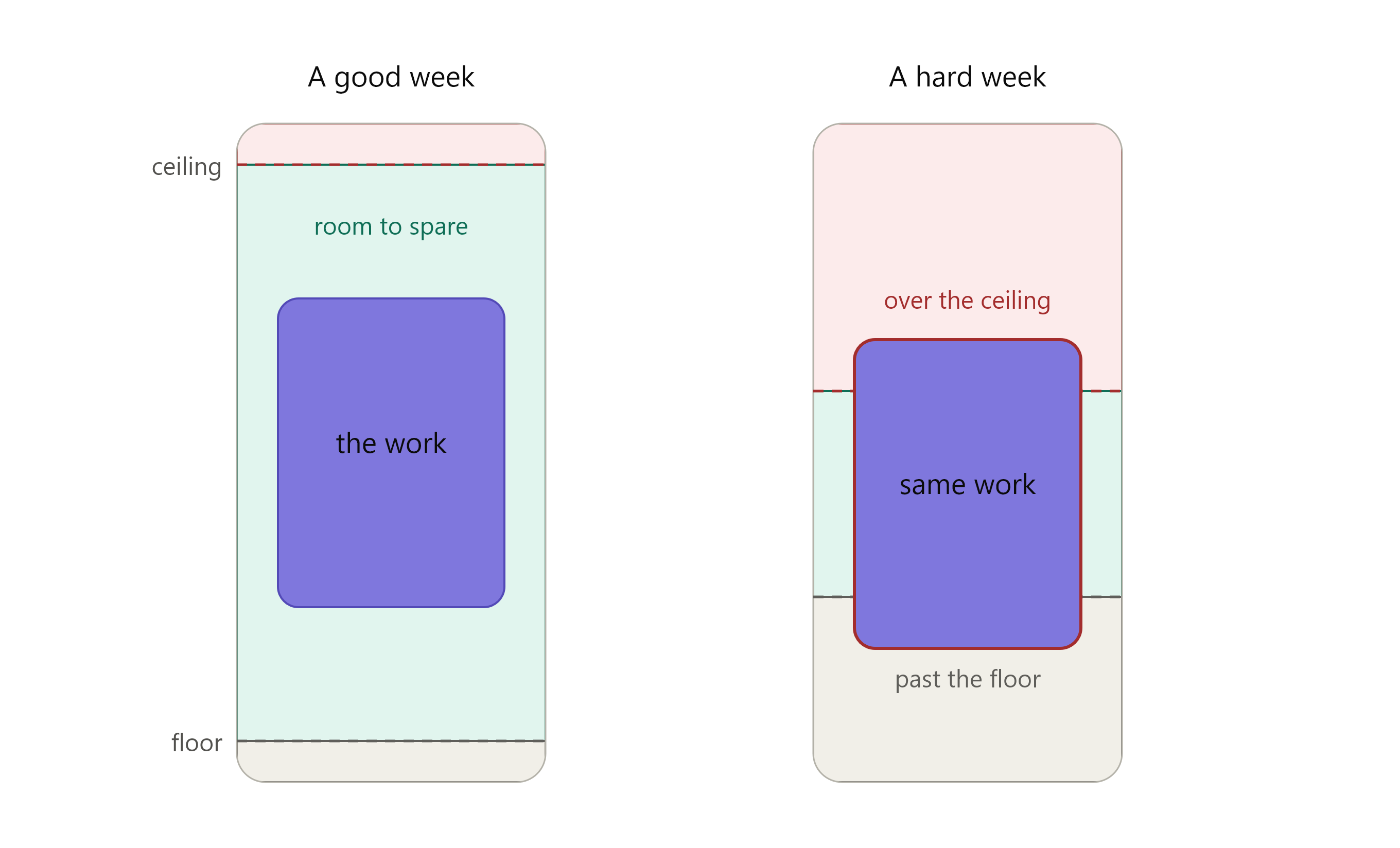 A model illustrating how neurodivergent capacity can handle a workload sometimes, but not others, without getting overwhelmed or overloaded.
One of the most interesting trends I uncovered was how often the neurodivergent person I was interviewing or coaching was actually overfunctioning already.
They’re running a business, but they’re also caregiving and/or parenting, in a band, in one or more clubs, keeping up a demanding hobby schedule, traveling fulltime, managing one or several chronic illnesses… and they’re doing it all while neurodivergent and often, late diagnosed - so unmasking and learning tools.
Every single one of these people had what I call a nervous system ceiling - the maximum stimulation and demands that they can hold on an ongoing basis before something breaks…
… and a capacity floor. A level of functioning that is the bare minimum required from them, no matter what, because of other responsibilities relying on them.
And when everything else in life gets hard and the business isn’t on fire, guess what takes a back seat to everything else?
But business advice isn’t built for people like this. Business advice is built for people who have essentially unlimited nervous system regulation (or the support and privilege for that to be possible) and no minimum demands on them when their business needs extra effort.
Neurotypical cishet white dudes with wives or parents to do all of the responsible things and venture capitalists backing their bills are the “default” that business advice is given to. Everyone else just gets modified versions of that advice, instead of different advice.
Marketing and visibility have to fight through a lifetime of shame and rejection.
Section titled “Marketing and visibility have to fight through a lifetime of shame and rejection.”Yes, it’s scary for everyone to put themselves out there. Let’s not pretend anyone has it truly easy. But for a neurodivergent person who has spent a lifetime being misunderstood, rejected, made fun of, or being the subject of jokes?
Marketing yourself as the face of something doesn’t make you a bit anxious, it makes you confront every single one of those situations and do it anyway - often in the face of deep-seated shame and worries about being immoral for accepting money.
“Extroversion and bragging makes me really uncomfortable.”
“Most of the marketing and sales stuff terrifies me. I get overwhelmed really easily.”
This isn’t a lack of desire, it’s rejection sensitivity dysphoria creating a cycle of genuine aversion, pushing through, and a shame spiral each time it backfires.
Many of the founders with these challenges even express a strong desire for their work to be known around the world; to stand on stages and speak in auditoriums; to be bestselling authors.
Whether they want to fade into the background and run a faceless company, or the the next thought leader celebrity, the shame cycle is the same.
Fear is always there.
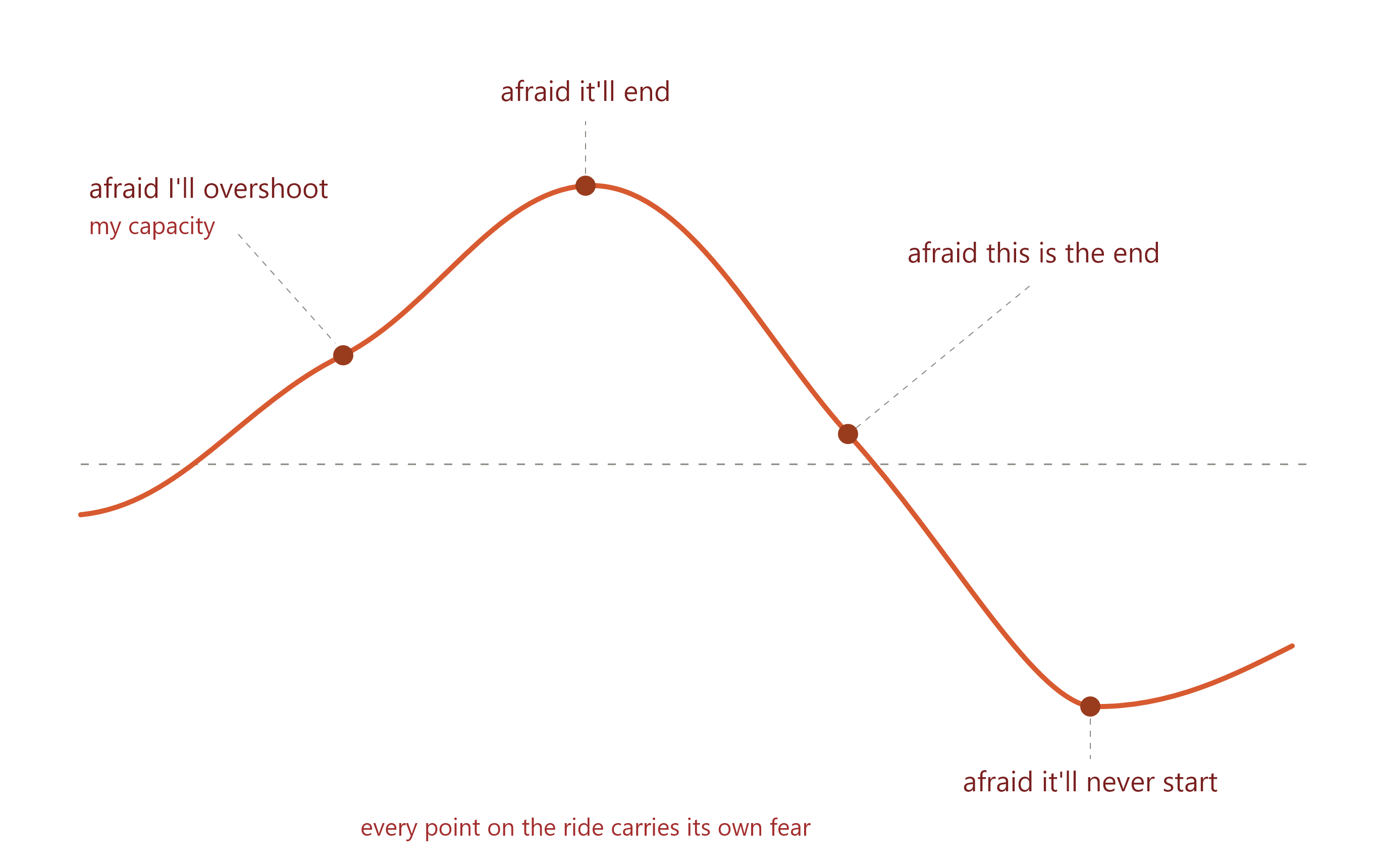
Section titled “Fear is always there.”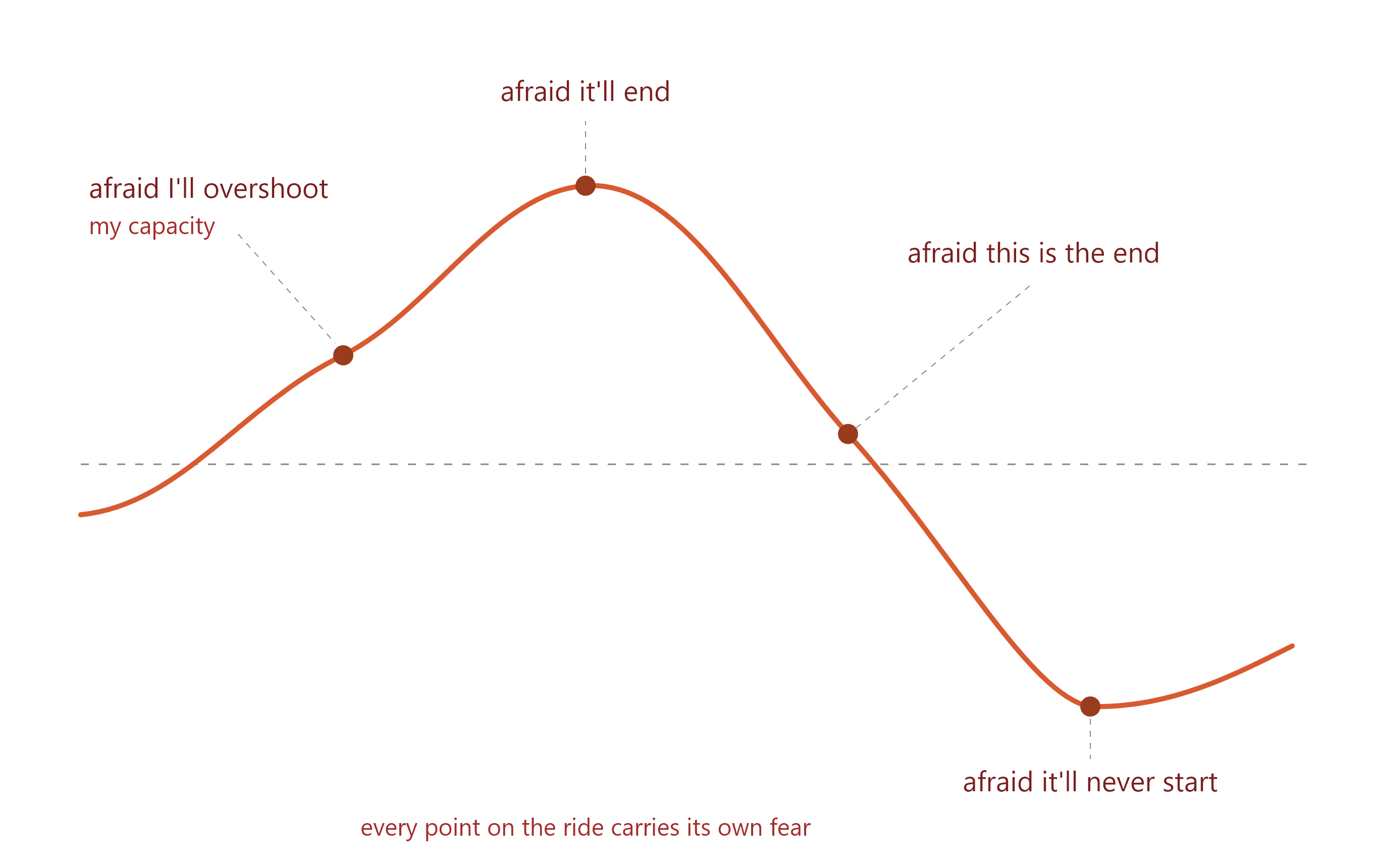 The four parts of the fear cycle that neurodivergent founders seem to experience in a persistent, overbearing loop.
When things are good? They’re afraid it’ll end.
When things aren’t going as well? They’re afraid it’ll never start.
When things start picking up? They’re afraid it’ll go too well and overshoot their capacity.
When things start slowing down? They’re afraid this is the end of it all, and things will never get back to good.
Impostor syndrome and the fear of getting found out; revenue rollercoasters and the fear of going back to a job; the fear of sounding fake, of getting cancelled, of doing something that others disagree with and having it all come tumbling down.
It’s very rare to speak to a neurodivergent entrepreneur who doesn’t have this constant undercurrent of fear, colouring every edge of their work at one point or another. And the mental and emotional load of operating in spite of that fear every single day?
Exhausting beyond what anyone could imagine, if they don’t have to live it.
With the mainstream presence of AI, this is especially prevalent.
If I don’t use AI, I could get left behind. And then what? My business will be gone.
But if I do use AI, I don’t agree with the way it was trained or the environmental costs right now. What if my audience, my clients, my family and friends reject me for using it - even if I try to use it responsibly?
The thing about this type of fear is that there is no right answer. This is not simple anxiety where someone is worried about one possible scenario. To the “all or nothing” thinking of the neurodivergent mind, there are two - or more - possible outcomes, and all of them are bad.
Money is emotional - and it’s safety.
Section titled “Money is emotional - and it’s safety.”One of the neurodivergent experiences discussed less in entrepreneurial circles and online content is the experience of repeatedly having to learn that other people are not like you.
Us founders with ADHD and/or autism tend to believe that others have similar lives and lived experiences, and therefore will feel the same way about things and value the same things and even see things the same way.
This can show up in all sorts of places, often leading to some rather upsetting feelings of naivete after being taken advantage of or not understanding a situation.
But this shows up with money the most.
Almost every founder I’ve worked with or interviewed has, at one point or another, tried to ensure that they could afford themselves.
And if they couldn’t - or wouldn’t - pay the price suggested for their work? They wouldn’t charge that price unless and until they realized the truth:
Other people have different financial circumstances and levels of comfort than they do, and prioritize their spending differently.
For much of the time when I was running my agency? I couldn’t have afforded my own services, and I wouldn’t have paid that much for them. Why?
Because I knew how to do them and had a team in place, and it wasn’t a spending priority for me. My clients had different needs, budgets, and teams.
And when money gets messy? Regulation goes out the window.
They are genius strategist and implementers, not true founders.
Section titled “They are genius strategist and implementers, not true founders.”While this is likely a result of who I was specifically polling, over and over again the pattern showed up:
They were absolutely genius at strategy or implementation for their clients, and saw running a business as a means to an end - not the goal in itself.
They were founders of circumstance. The only way they could work in the way that suited them best, make the money they needed to make, and truly have any enjoyment from their work was to work for themselves. They don’t usually have the same drive for massive venture capital backing or business growth for the sake of it, but rather operate lifestyle businesses that capitalize on their passions.
This also means that everything outside of their zone of genius is a lot less fun, and lot more challenging to stay motivated with. Many of these founders will do just enough of the business operator things to keep the business running, and then go back to their comfortable, passionate role as an operator or strategist.
Standard advice just doesn’t fit.
Section titled “Standard advice just doesn’t fit.”Everything from “just be consistent” to “it’s a volume game” and “don’t take it personal, it’s just business” are meant for founders with totally different wiring than neurodivergent entrepreneurs.
Years trying to make this advice work by batching your content or cold emailing by the hundreds or gaslighting yourself into violating your own boundaries to make a business model fit you can leave neurodivergent founders questioning themselves, wondering if they’re just not cut out for this, wondering if the advice is good and they’re just bad at implementing it.
Hopefully all of these patterns and trends from my research have shown you that the problem isn’t you or your ability to run a business - the challenges come from a mistmatch between the typical advice and your neurotype.
So here’s what works.
Section titled “So here’s what works.”We talked a lot about why it is harder to run a business as a neurodivergent founder, but let’s spend some time talking about how to actually make your business work.
Relationships > audience
Section titled “Relationships > audience”Warm, relationship-based marketing works for neurodivergent people (in spite of any social challenges.) Referrals, word of mouth, in-person connection, content to connect and relate to others instead of broadcasting, channel partnerships, training and teaching… You’re always wanted, always invited in, and never have to push. Well over 60% of subjects tracked had referrals and relationships as not just a primary, but the dominant or sole source of new clients.
Peers and community bring structure
Section titled “Peers and community bring structure”Body doubling, while not requested by everyone, was the number one cited accommodation in terms of impact - but not everyone likes it. So it shouldn’t be applied universally, but it can definitely be helpful if you’re struggling to get things done.
Rest, regulation, and capacity awareness are key.
Section titled “Rest, regulation, and capacity awareness are key.”Over and over again, what restored momentum for clients and interviewees wasn’t pushing harder - it was protected rest, treated as preparation. Regulating the nervous system before trying to work toward a goal universally helped neurodivergent founders to succeed faster, and more often.
What we can learn from this.
Section titled “What we can learn from this.”You might have been hoping I’d come out and bring you some magical marketing tactic that works universally for all neurodivergent folks, regardless of their business, needs, or neurotype… And then you’d be done.
After all - “Just tell me what to do and I’ll do it” is the thing I’ve heard most.
But the reality of it is, after looking over my records of contact with roughly 100 neurodivergent founders across five years… It’s not a skill issue.
You know what to do. In fact, you’ve probably exhausted yourself trying so many different things that all technically work, precisely because you know what to do.
The reality is, you’re constantly told that the way that works for you - referrals, word of mouth, partnerships, guest trainings, podcast guesting, channel partnerships, affiliates, joint ventures, newsletter swaps, live events, networking, however you want to do it - isn’t the “right” or “proper” or “official” or “professional” way to do business. You’re told that the reason you’re burning out is because those methods can’t be reliable and can’t consistently bring you sales.
And this research, along with the twenty years I spent running an agency exclusively using those tactics, prove that to be incorrect.
Everything works, if it works for you. And the marketing tactic that is going to perform best? Is the one you’ve got the capacity to stick with.
About the author. Cheryl Woodhouse is the neurodivergent founder of Tactile Design Co, a marketing agency she has been running since 2005. During a short break from agency work, she created NDFounders.com to publish her research and writing in support of fellow neurodivergent entrepreneurs. This report synthesizes her original research and interviews, along with anonymized coaching insights, from approximately 100 individual ND founders between 2021 and 2026.
You can learn more about ND-specific coaching and support for service-based ND founders at soloschool.ca, support for software-based ND founders at craftsoftwarecollective.com, access an ND-assistive content marketing tool at runitbyalex.com, or engage with her agency services at gettactile.com.
From NDFounders — free to use and teach with attribution. Licensed CC BY 4.0. Cite as “NDFounders (ndfounders.com)”.